Everyone Has the Answers Now. That's the Problem.
It's my birthday next week. I'll be 56 years old. I'm not one for looking back, but business wise it's been a few weeks of reflection (and not just pondering how it can be so swelteringly hot for so long!).
I started Business Think on my birthday twenty five years ago, and consultancy and marketing have changed enormously over that time ...
Back then you had to:
Drive a lot. There was no Zoom.
Assume a lot. We didn't have the analytics and real-time data we have today. None you could really rely upon anyway.
Explain a lot. There was often a big technology gap between what a consultant knew and what the customer knew.
All of that has changed in recent years. And I think most of those changes have been good for businesses.
Less time driving means more time actually working on growth. More data means ideas and decisions can be based on evidence rather than assumptions. And customers have access to far more knowledge themselves, so there is less opportunity for anyone to bamboozle them with jargon. Accountability is up.
That's been good for my business too. More billable hours, more transparency and trust, and less time spent explaining the basics of what we're about to do.
Less waste all around, for everybody.
But there is another consequence.
If businesses can increasingly do the basics themselves, what are they actually paying a consultant for?
I've always taken the view that if a customer can do something themselves for free, they should. I'll happily show them how. I don't think less need for traditional consultancy is a bad thing. I think it means consultancy has had to up its game. If the basics of marketing are accessible to everyone, there isn't much of a sustainable future in selling 'easy' tasks.
Consultancy, coaching, marketing and website development have to deliver more. They have to help with implementation, not just ideas (saving time). They have to provide reassurance when businesses are making investments (increasing confidence). And increasingly, they have to help businesses interpret a huge amount of data, information and advice, much of which can now be generated in seconds by A.I. (reducing errors).
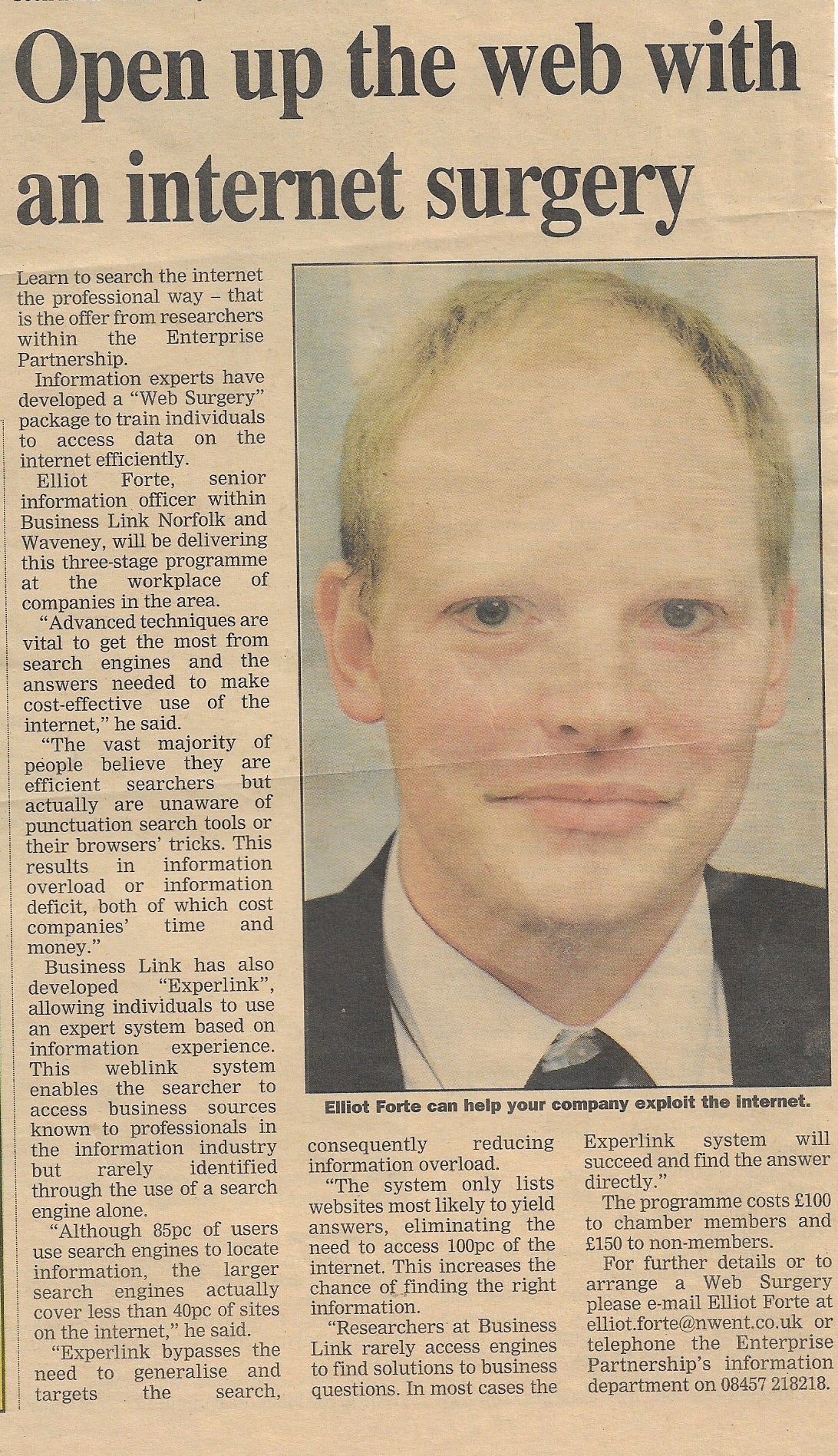
Which brings me back to something I learned 25 years ago.
Before starting Business Think, I spent five years working in a business library and completed professional search training through the Association of Special Libraries and Information Bureaux. Yes, search training. It sounds almost ridiculous now.
How difficult can searching be?
You type in a question or a few words and get an answer.
Except that wasn't what we were taught.
A professional searcher asks the same question in different ways. You look differently at what comes back. You question the source. You test the information. You look for what might be missing or misleading before using it to reach a conclusion.
In short, working in that business library taught me how to help people make better decisions.
It is probably the only training I've received that I have used every single day of my professional life.
And strangely, I think it's becoming more valuable rather than less.
Because we now live in a world where information isn't difficult to find. It's everywhere. Analytics give us enormous quantities of data. Search engines give us thousands of results. A.I. can analyse information, generate ideas and answer extraordinarily complicated questions in seconds. That's incredibly useful.
But there is a flip side.
If you ask the wrong question, use the wrong data or believe a recommendation too easily, you can arrive at a completely wrong conclusion. A.I. can also 'hallucinate', confidently generating information that isn't necessarily true, which can lead to misplaced confidence and unconscious risk taking.
I think that's becoming a significant threat for many businesses. The speed and apparent certainty of the answer can make it very easy to stop questioning it.
Interestingly, when I started Business Think in 2000, I was naive enough to think my search skills were so valuable that businesses would pay me for them. Of course they wouldn't. Everyone thinks they can search. Everyone could see a set of results. It's incredibly difficult to convince someone that something which appears so simple is actually complex.
So I quickly realised that these skills were better used as a secret weapon, so to speak. I could apply them to the things businesses did value. Coaching. Consultancy. Training. Website development. Marketing. Everything.
I think that ability to find information, question it, test it and turn it into something useful has probably been one of the main reasons I've managed to stay in business for twenty five years.
And perhaps we've now gone full circle.
In 2000, good information could be difficult to find.
In 2026, answers are incredibly easy to find.
The difficult bit is knowing whether you've asked the right question, whether you can trust the answer and what you should actually do with it.
So this isn't a pitch to sell you 'searching'. Twenty five years later, I still don't think I'd have much luck with that! It's simply a reflection that the tools may have changed beyond recognition, but one of the most valuable business skills hasn't.
Knowing which questions to ask.
Knowing how to test the answers.
And then using that information to make better decisions.
A.I. hasn't made that skill obsolete. I think it's made it more important than ever.

This article was written by Elliot Forte, founder and Director of Business Think, a business strategist, digital marketing specialist, and educator with over 25 years’ experience supporting thousands of organisations to grow and adapt in an evolving marketplace. The views expressed are solely those of the author and are based on his professional experience working with businesses across a wide range of sectors.
If you would like to work with Elliot, explore collaboration opportunities, or discuss how he can support your business growth, please get in touch.